Monday, December 7, 2015

You Want the Truth?! You Can't Handle the Truth!


            For those who don’t know, Blade Runner is easily one of my top 5 favorite films of all-time, and it’s certainly Ridley Scott’s magnum opus. I mean don’t get me wrong, Alien is a masterpiece in and of itself and the fact that a sequel was never made is just as much of a tragedy as the lack of a follow-up Matrix film and the fact that Coppola never made a third Godfather. Oh well, perhaps such things are for the best.
no nope dumbledore harry potter smh
As far as I'm concerned they don't exist.


             Recently, however, Scott has been working on a new project which I believe has the potential to be one of the best pieces of media of this decade. No, I’m not talking about his upcoming adaptation of Haldeman’s The Forever War, which is set to star Channing Tatum in the technological wonder that is 3D. In fact, I’m not even talking about a film to begin with. Instead, what I’m referring to is the recently released Amazon Prime original series entitled “The Man in the High Castle,” a 10-episode adaptation of the Philip K. Dick novel by the same name.

Image result for the man in the high castle

On a superficial level the plot is hardly anything new: the year is 1962, the Axis powers have won World War II, and the world – along with those left in it – are ruled by the Greater East Asian Co-Prosperity Sphere on one side and the Greater German Reich on the other. Meanwhile, the former United States, in a historical analogy which goes right over my head and for which I see no real-world comparison, is split down the middle, with the German Empire controlling the territory from the Eastern seaboard to the Rocky Mountains, and the Japanese controlling the West. Between the two is a no-man’s-land called “The Neutral Zone” in which those who have been termed dissidents and undesirables scrape out what little they can, free from the reach of the two superpowers. With the Germans possessing a clear technological advantage thanks to their sole understanding of nuclear technology, conflict between the two seems inevitable and who the victor will be is apparent to most.

nazi dinosaurs danger 5
That's not even factoring in their far superior dinosaur technology!
“But this is alternative history and the series is as relevant to the field of Public History as Jurassic World!” I can already hear you begin to type out. However, there’s one major plot point which I’ve missed. Since this is alternative history told by Philip K. Dick and Ridley Scott, the series wouldn’t be complete without philosophical conundrums along the lines of “what is reality”, “do we even exist”, and “how does that creepy guy with the bionic eye know I dream about unicorns?” Central to the plot are a series of film reels supposedly produced by the eponymous “Man in the High Castle” which depict our own reality in which the Allied powers were victorious. Those in the series who actively oppose the German and Japanese governments believe that these films, even more so than guns and other weapons, are their best chance at doing so. And on the other side, the Axis powers believe that these films pose one of, if not the greatest, threat to their rule.
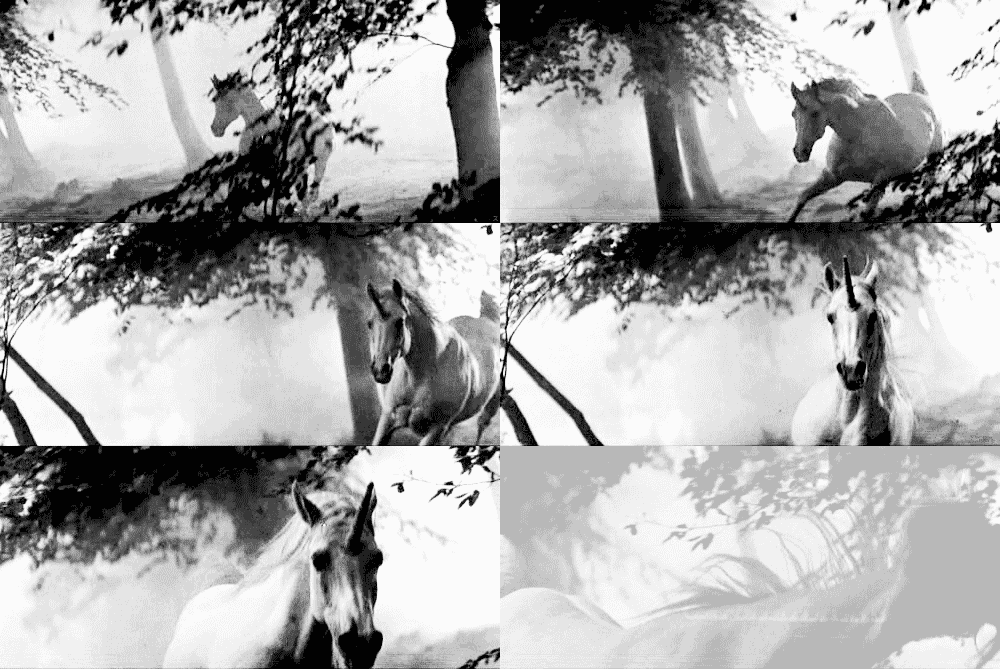
black and white 80s fantasy dreams scifi
Ridley, that is very clearly a horse with a carrot glued to its head. You're not fooling anybody.
Aside from their use as a plot device, though, these films serve as a useful vehicle for exploring the intersection between historical cinema, especially so-called “revisionist” films, and history proper. As noted film historian Robert A. Rosenstone once wrote, filmmakers who produce historical films are “cinematic historians,” despite how often the mainstream academic community may object. In his mind, the world of cinematic history and the kind of serious, capital H “History” taught in classrooms have far more in common with each other than one might initially expect. For instance, although they each “refer to actual events, moments, and movements from the past,” according to Rosenstone the two disciplines both “partake of the unreal and the fictional, since both are made out of sets of conventions we have developed for talking about where we human beings have come from.”[1]

burn bullshit joe biden malarkey

By choosing to use history as subject matter, portraying it in a way that runs counter to traditional modes of understanding, directors open themselves up to a wide variety of criticism ranging from a lack of objectivity to accusations of blurring “almost beyond distinction fact and fiction, historian and subject.” For many professionals, the merging of artist and scholar that a director represents compromises the depiction of “actual persons and events” in favor of “colourful imagery, concocted dialogue, and imaginary people.”[2] But can academic historians really say that they aren’t prone to making these very same “mistakes” themselves?
idk i dont know

I very much doubt that there has ever been a historian who has not carefully chosen the words they use and the information they choose to include in order to improve their final product. And even if we assume that they don’t, do we, as consumers of popular media and scholarly work alike, really want the former to be as dry and monotonous as these critics seemingly desire? There are certain elements of history that movies are simply better at conveying than text, not just in spite of their artistry but because of it. Can a book so vividly depict the mentality of American soldiers in Vietnam à la Platoon or Full Metal Jacket? Furthermore, would our society’s understanding of the reality of war, and the atrocities committed on both sides, be as complete if it wasn’t for these films?[3] I don’t know about the rest of the country, but I’d much rather watch a movie than read a Pentagon report and I’d probably take more out of it as well.  

book beauty and the beast reading the more you know gaston
me irl
Now mind you, this isn’t to say that fanciful turns of phrases and the admission/omission of certain information in books due to narrative concerns are anywhere near the same thing as depicting an entirely different outcome to World War II. Nor am I trying to convey the message that works of capital-H History take anywhere close to as many artistic liberties with the subject matter as do films, or that we should completely disregard scholarly works and fully switch to the visual image as a medium for learning.

movies pizza netflix link travel
Actually on second thought...

However, it’s my belief that the story of “The Man in the High Castle” offers a few interesting lessons for its audience. The first is that the written word is just as much a product of editing as are films, and that there can be as many different depictions of the past as there are individual works. The second and more important point, though, is that this discrepancy in what is depicted isn’t something to be avoided but welcomed. By juxtaposing these different interpretations, amateur enthusiasts and professionals alike are afforded valuable insight into history and its formative process. Chances are you (hopefully) won’t be hunted down by the secret police for your dutiful investigation into the nature of truth and fact, but who knows? It might prove to be a worthwhile use of your time.  


[1] Rosenstone, Robert A. History on Film/Film on History. Harlow, England: Longman/Pearson, 2006. 2.
[2] Rosenstone. History on Film. 127.
[3] Rosenstone. History on Film. 134.

Sunday, November 29, 2015

Misplaced Histories

Misplaced Histories

    On February 19, 1942 President Franklin D. Roosevelt signed Executive Order 9066 that authorized the deportation and incarceration of over 100,000 Japanese Americans living on the Pacific coast, placing the internees into relocation sites across the United States in designated military internment areas. These military internment camps were active from 1942 to 1946 and represent the distance the government and the public are willing to go in the midst of war and fear. Nearly seventy years later the memory of these events and the physical memorial sites still reflect the contested narrative public historians are struggling with. One of these internment camps was nearly lost to faded memories until a local high school teacher founded the Amache Preservation Society and the internment site entered the National Register in 1994.


                           See the local high school teacher speak about the Amache Relocation Center history

    The Arizona Daily Star recently published an article on the Amache Japanese-American Relocation Center along the Colorado border near Granada. For over a half-century the Amache internment camp was recognized by a single sign along a lonely back road. A single tattered sign was all that remained - the camp itself was nothing more than fields and farmland where once 7,000 Japanese-Americans were imprisoned. Even today, such a significant event holds little sway with larger, more visible national parks.  Associated Press journalist Russell Contreras writes in his article “If you aren’t careful on this southeastern Colorado rural highway, you might easily pass the signs leading to a site that marks a dark and unjust episode in U. S. history.” (See the full article here) Contreras article

This is the "hard-to-miss" sign to the Amache camp


    In A Misplaced Massacre Ari Kelman suggests “the act of remembrance, no matter how painful, will strengthen the foundation upon which the nation is built.” But what does it mean when a memorial is forgotten or neglected? Contreras describes the current Amache camp: “Behind the dry bushes sit lonely concrete slabs that once housed makeshift homes, a school, even a dancehall.” Today, the only standing object is a recreated guard tower. This neglect and lack of federal funding captures the long forgotten and painful memory that Kelman eludes to in her monograph. Among those forgotten memories was an imprisoned cartoonist for Walt Disney, a WWII Medal of Honor recipient, a camp newspaper, the Granada Pioneer, and even a football team. Yet Contreras communicates this neglect, “Visitors might drive around confused if not for the informative billboards at the camp's entrance explaining the locations and showcasing photos from Amache daily life…[and] tour the 600-acre camp with narrowly paved roads.” Contreras suggests this “is a place to wander, meditate and take an occasional photo. The rest is left to the imagination.” But is this the vision of the Amache camp designers or is this a result of forgetfulness? Despite the long forgotten memory of Amache in the last few years the past has returned thanks to the continuing cooperation of the National Park Service along with the Friends of Amache, the Amache Club, the Amache Preservation Society, and the Town of Granada who have produce a Comprehensive Interpretive Plan and Conceptual Development Plan outlining the interpretive, educational and site goals for Amache. An essential element of their plan includes returning buildings to the site, primarily barracks and other iconic structures. The plan also describes the need for a visitor center and additional educational and interpretive opportunities for site visitors. This collaboration among ancestors, local history organizations and the NPS reminds us of how, like the Sand Creek site, can serve as a model for successful partnerships representing painful national memorial sites as Kelman hopefully writes “perhaps the massacre will no  longer be misplaced.” Such local engagement of historical sites contextualizes what events in American history are remembered and which are neglected and provides guidance on how public historians  may continue to advance the field.
Likewise, perhaps the memory of Japanese-American internment camps and Native American historical sites will finally get the exposure and funding they deserve as Kelman ponders “whether visitors to the Sand Creek site are ready to broach such difficult topics, to reassess their homeland’s character and fate, remains unsettled.” A primary concern to public historians is the National Park Service and its role in preserving and interpreting American history. What does A Misplaced Massacre have to say about this? What is the role of public historians or the NPS in memorial sites? See the NPS site on public history sitesNPS

 Are we making progress in the realm of properly representing example of painful American history?

Also, check out popular culture representations of the Sand Creek Massacre in the film starring a young Dustin Hoffman and a heavy metal song by Iron Maiden grimly titled "Run to the Hills."


1. Russell Contreras. “Japanese-American Internment Camp Opens Forgotten History.” Associated Press, http://bigstory.ap.org/article/19220e114d6d4ba0847ce91748f02ecb/japanese-american-internment-camp-opens-forgotten-history
2. Ari Kelman, A Misplaced Massacre:Struggling over the Memory of Sand Creek (Harvard University Press, 2013), 4.
3. Contreras, “Japanese-American Internment.”
4. Ibid.


5. Ibid.


6. Kelman, A Misplaced Massacre, 279.
7. Ibid.


Saturday, November 7, 2015

Through These Gates: John E. Brent


The Burchfield Penney Art Center at SUNY Buffalo State is showcasing an exhibit featuring the city of Buffalo’s first African American Architect, John Edmonston Brent. It opened Friday, October 9, 2015 and will continue at the Museum through Sunday, March 27, 2016. The exhibition, which is titled, “Through These Gates: Buffalo’s First African American Architect, John E. Brent”, is co-curated by Nancy Weekly, SUNY Buffalo State instructor of museum studies and Christine A. Parker, SUNY Buffalo State graduate student and Diversity Research Fellow.
John E. Brent (1889-1962) was born in Washington, D.C. and named after his grandfather. His grandfather was born a slave and was later able to buy his freedom as well as his wife’s. John E. Brent’s parents were Calvin Thomas Stowe Brent and Albertine Jones Brent. John E. Brent’s father Calvin was the first African American architect in the District of Columbia and by 1876 he had established his own practice in the city.

John E. Brent attended to Tuskegee Institute from 1904 to 1907. After graduating from here he received the James MacAlister scholarship, this was a full scholarship that enabled him to continue his education at Drexel Institute of Art, Science and Industry. While here Mr. Brent studied Architecture, Landscape Design. Upon graduating from Drexel in 1912, Brent moved to Buffalo. Once he arrived to the city he found a job with Max G. Beirel, making him the first African American architect of the city. In 1926 Mr. Brent earned a State of New York Architect’s Certificate and License. Receiving this certification made it possible for him to start his own architectural practice. This led to the set-up of his home office, located at 99 Lonsdale Avenue in Hamlin Park. When I attended the exhibit it said on some of the labels that during the era that Mr. Brent lived, work was very difficult to come by. At the exhibit it left it up to those attending to decide whether this was because of the economic climate brought on by WWI or because of racial prejudice. It also mentions that sometimes even when work was available African Americans were not always credited for the projects they were involved in. Despite these circumstances, Mr. Brent was able to work on, and receive credit for, several projects. This includes the Mitchell Miles Residence and Myron McGuire, DDS Medical Office.
There are two designs he is probably most remembered for though.The first is the Michigan Avenue Branch YMCA, built in 1928. After the completion of this YMCA, Mr. Brent would go on to serve as a member on its Board of Directors. This YMCA in particular was important because it served as a safe place for African Americans to go to during a time when they were not welcomed everywhere. Though the structure was demolished in 1977, it will always be worth noting when reflecting back because of the impact it had on the community during its time as well as the fact that this structure designed by Mr. Brent was only the second YMCA  an African American was commissioned  to design. The second project Brent is known for is with the Buffalo Zoological Gardens. Produced in 1935, Mr. Brent is responsible for the design of Gate #3 and Gate #4 of the Buffalo Zoo. These Gates are cast iron, 8-ft. tall, and anchored in concrete piers. In 2013 the structures were listed on the National Register of Historic Places. In addition to his many professional endeavors, Brent also holds the distinct honor of becoming the first President of the Buffalo Branch NAACP on November 30, 1914.

As I attended this exhibit I couldn’t help but be reminded of one of our texts from class, “From Storefront to Monument: Tracing the Public History of the Black Museum Movement.” In the text the author, Andrea A. Burns, talks about the creation of four African American neighborhood museums, the DuSable Museum of African American History, the International Afro-American Museum, and the Anacostia Neighborhood Museum, and the African American Museum of Philadelphia. Burns speaks on the hardships facing African American curators in starting and maintaining African American museums and the exhibits within them. One example of a difficulty was highlighted with the African American Museum of Philadelphia. The problem here was that the original preferred location for the museum was in a neighborhood known as Society Hill and the residents living here were against the museum being built within their community. Another instance of a problem can be found with the International Afro-American Museum located in Detroit, Michigan. In the text it said “The lack of usable artifacts… stemmed from the persistent neglect and diminishment of black history by most mainstream institutions.” This connects with the John E. Brent exhibit being showcased at the Burchfield Penney Art Center. As mentioned previously, African Americans did not always have their name attached to the projects they worked on. In order to provide a better idea of what his resume may have truly encompassed the Burchfield Penney also listed several projects that took place during his career that, while not officially being credited for it, may have included his input one way or another.
In the text, Burns explained that one of the primary reasons for the creation of the African American Museum of Philadelphia is the fact that it would have been a public relations nightmare otherwise. When related back to the John E. Brent exhibit, while the Burchfield Penney is not an African American museum, I think it just shows the evolution in the mindset of the powers that be that it doesn’t have to take an event as large as the anniversary of the country to pay homage to the history of African Americans. Something I believe the Burchfield Penney Art Center has in common with the four museums discussed in the text is its dedication to the community. While those museums worked to serve African Americans in their community, the Burchfield Penney serves the entire Western New York area.

Sunday, November 1, 2015

Communist PARTY!: State Sponsored Living History in China

Amy M. Tyson’s 2013 book, The Wages of History, is an in-depth study of the professional reenactors employed by Fort Snelling, a historical site in Minnesota.  Her argument, eloquently explained on page 23, is that “those who chose to invest themselves in the worksite did so because they found it emotionally fulfilling to connect with others through the medium of living history.”[1]  To understand form and content at living history museums, Tyson continues on the next page, “we need to understand the larger contexts that shape the working lives of those delivering that content: public history’s front line.”  Her study, however, is very limited in scope: she takes her findings mostly from Fort Snelling, only occasionally discussing events and exhibits at such other living history museums as Colonial Williamsburg.  I decided to take a look at the form and function of another group of living history sites.  For this blog post, we’re going traveling.


In this class, we tend to focus quite a bit on America.  All of the books we’ve read have been about American museums, or ways in which America chooses to look at public history.  Well, other countries have museums too, and other countries do living history as well.  Reenactments of the English Civil War take place in Britain, as well as Roman Legions.


  Napoleonic events draw great crowds in Europe, especially during the bicentennial events of recent years. 


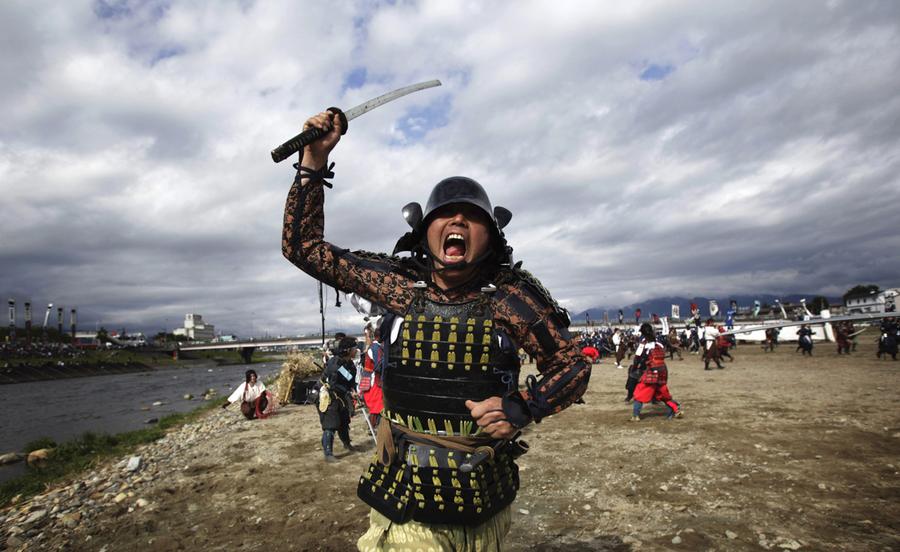
  Japan has very impressive samurai reenactments.  


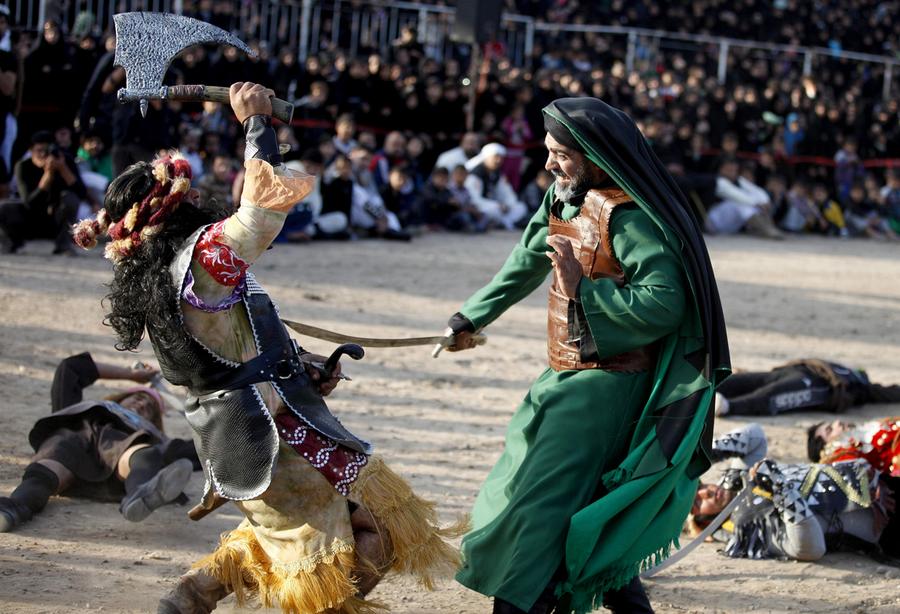
Shiite Islam has transformed reenactments in Iraq into popular religious events, as has Catholicism in the Philippines.  


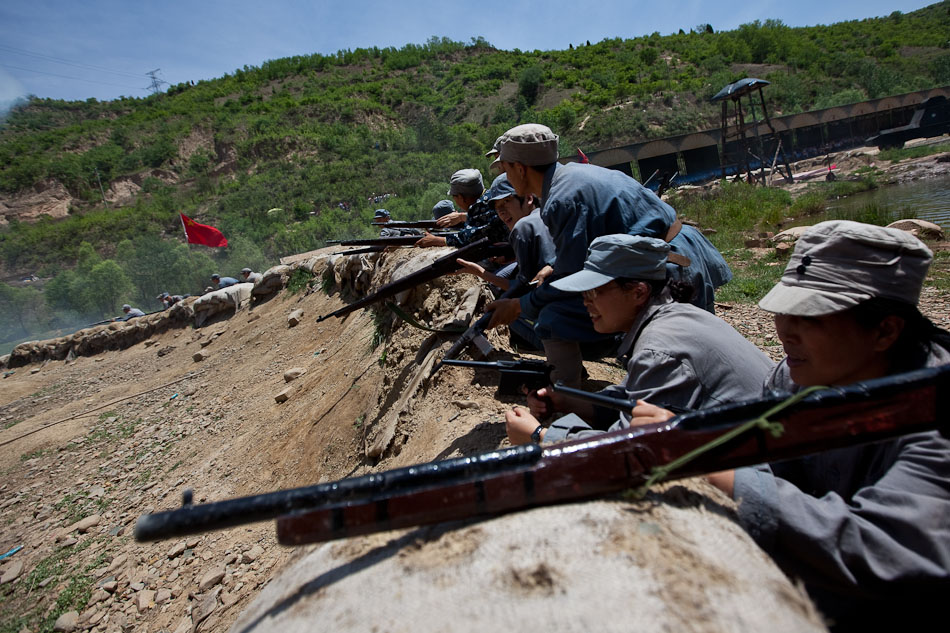
But most of these events last a single day, or in some cases, a weekend.  However, things are a little more extreme in China. If you want to see the battles of the Chinese Civil War, you can go anytime: there’s a battle every day at 11AM, and sometimes two battles on weekends.  And for a small extra fee, you can fight in them.


“Red Tourism,” or tourism based around sites that have a significance relating to the history of the Chinese Communist Party, is taking off in China.  Much of this tourism is to places in the city of Yan’an, in Shaanxi Province, central China.  Yan’an was an endpoint on the Long March, and was seat of China’s communist government from 1937 until 1947.  The city of Yan’an was home to Mao Zedong during that decade, and many communist leaders spent time living and training there.  Yan’an was captured in March of 1947 by Chiang Kai-Shek’s nationalist army, and it is this battle that the Yan’an reenactment focuses on.


Three hundred and fifty paid actors reenact the battle of Yan’an for one hour every day.[2]  The battle features Nationalist KMT and Communist soldiers as well as peasant villagers, and involves artillery, tanks, and even a model airplane.  The performance costs 150 Yuan to watch, which equates to roughly 24 USD.  Participating in the production costs the interested visitor only an additional 50 Yuan (~8 USD).[3]  After the battle, those who wish to may take a photo in either communist or KMT uniforms, or even take a photo with an actor portraying Chairman Mao himself.  The entire performance is filmed, and participants and spectators alike may purchase a DVD copy after the battle.[4]


Yan’an has more to offer the Red Tourist than just the battle.  A visit to Yan’an is incomplete without a tour through the Yangjialing Caves that Mao and his followers lived in for a decade.  The three rooms of the cave are extremely neat and clean, with Mao’s bed made up all nice and tidy.  Those wishing to live in closer communion to Mao may stay at the nearby Yangjialing Cave Hotel, built into the side of a mountain in traditional Shaanxi style.[5]  A nearby exhibit hall discusses Mao’s life and policies, but only their positives: there is no mention of famines caused by poorly thought out agricultural reform policies, the horrors of the Cultural Revolution, or brutal political purges.[6]  Other important Red Sites in and around Yan’an include the Zaoyuan Site, caves home to the CCP Secretariat 1943-1947, and a meeting hall for the Central Military Command.  Red-themed restaurants such as Red Classics cook up northeastern Chinese food, served by waitresses in the dull blue cadre uniforms of the CCP.[7]  A Long March-themed amusement park has even been proposed to city, turning a traumatic event that killed thousands into a fun day out for the family.[8]


2011 was a peak year for Red Tourism because it was the 90th anniversary of the founding of the Chinese Communist Party.  In the year 2013, 786 million Chinese tourists visited over 100 Red Sites, spending a total of 198.6 billion Yuan (23 million USD) on their travels.[9]  An article by The Guardian reports that Chinese sources claim 2,000 visitors to Yan’an’s Red Sites every day.[10]


Garish and kitschy though the Yan’an sites may appear to be, many Chinese tourists approach them with a sort of reverence.  Many members of the Party come on tours of Red Sites to reaffirm their allegiance to the Party, and to try and understand the Party’s history. A visiting member of the Party explained why Red Tourism was so popular to BBC reporter Michael Bristow: "We do this to review history, strengthen our faith in the party, uphold its traditions and improve our work.”[11]  Ma Xiaoyu, a female teenage visitor to the Yan’an sites, was quoted in The Guardian saying that she came to Yan’an because modern Chinese “really wanted a look at how Chairman Mao and those leaders lived in those times. They built up the new China, so we need to remember them."[12] She went on to say that visiting these sites and dressing in the dull blue uniform of a cadre makes her feel patriotic.  Wu Kunliang, a middle aged engineer, came to Yan’an’s Red Sites with his family. “Coming here helps one understand China’s red spirit,” he told Dexter Roberts and Jasmine Zhao of Bloomberg.[13]


I find the thoughts of the participants to be more interesting than those of the spectators.  Interviewed by Time Out Shanghai, an actor who plays a Nationalist soldier explains how he feels: “It’s hard work – we perform all the time, even in the rain. There’s always a crowd here to watch.”[14]  He makes 1,500 Yuan (~236 USD) per month, and drives a motorcycle during the event.  The event has a very definite pro-communist (and anti-KMT) slant, so Time Out Shanghai asked about the ratio of KMT to CCP soldiers.  Surprisingly, recruitment on the two sides is fairly even. “If you act with the Kuomintang, you get to ride on motorbikes and things, but if you’re with the Communists there’s more running involved.”  Tang Qunshan, a 27-year-old visitor to Yan’an who also decided to join the Nationalists, told Reuters that “by traveling to old revolutionary sites and taking part in activities like these, I think we can experience the spirit of those old revolutionaries."[15]


But why Red Tourism?  Is it simply just a public trying to understand its national history?  Perhaps there’s a darker political significance.  China’s communist government isn’t exactly known for presenting history honestly.  The government is in strict control of all these sites, and it is the government that decides how to portray this history.  In Shanghai, a sign at the site of the Party’s first congress sums up the message of the Red Sites: "The founding of the Communist Party of China is the inevitable outcome of the development of China's modern history.”[16] There is no alternative view of history here.  The Communist Party was always destined to win.


So, it’s easy to list the disadvantages of government control of public history, but are there any advantages?  How involved in history presentation (and living history in particular) should the government be? 


In The Wages of History, Amy Tyson describes the difficulties that American living history sites had in dealing with traumatic events from the past, such as slavery and relations with indigenous peoples.  It appears that China has fewer issues with the “cleaning up” of horrific battles and divisive social conflict, especially with the plans to build a Long March-themed amusement park.  Does America have any analogues to Red Tourism, such as Revolutionary or Civil War history sites?  How do these sites compare to China’s Red Sites in terms of propaganda, messages, and presentations of history?


The Yan'an Battle can be seen in disappointingly low resolution here (no English)


                    A video of a similar show in Shaanxi can be seen here (with English!)


 For those interested in seeing more international Living History photos, check out these two photo essays from The Atlantic:

Try it sometime. Who knows, maybe the costumed life is the life for you?


                                                                         Me in real life.


[1] Amy M. Tyson, The Wages of History: Emotional Labor on Public History’s Front Lines, (Amherst and Boston: University of Massachusetts Press, 2013), 23
[2] Dexter Roberts and Jasmine Zhao, “In China, Red Tourism Stages a Comeback,” Bloomberg Business, July 10, 2014, accessed October 30, 2015, http://www.bloomberg.com/bw/articles/2014-07-10/chinas-patriotic-red-tourism-makes-a-comeback
[3]Jake Newby, “Tour the ‘Cradle of Revolution’ in Yanan,” Time Out Shanghai, October 17, 2013, accessed October 30, 2015,  http://www.timeoutshanghai.com/features/Travel-Travel_around_China/14831/Tour-the-cradle-of-the-revolution-in-Yanan.html
[4] Kirk A. Denton, “Yan’an as a Site of Memory in Socialist and Post-socialist China.” In Marc Matten, ed., Places of Memory in China: History, Politics, Identity, (Leiden: Brill, 2011), 271
[5] Newby, “Tour the ‘Cradle of Revolution’ in Yanan.”
[6] Edward Wong, “Revolution isn’t a Party, but it Draws Tourists,” The New York Times, December 30, 2010, accessed October 30, 2015, http://www.nytimes.com/2010/12/31/world/asia/31china.html?_r=0
[7] Maxim Duncan, “China’s ‘Red Tourism’ puts the Party back into Communism,” Reuters, June 30, 2011, accessed October 30, 2015, http://www.reuters.com/article/2011/06/30/us-china-party-tourism-idUSTRE75T19J20110630
[8] Denton, “Yan’an as a Site of Memory,” 273.
[9] Roberts and Zhao, “In China, Red Tourism Stages a Comeback”
[10] Tania Branigan, “Communist Heritage is Good Business as China Prepares for 60th Anniversary,” The Guardian, September 27, 2009, accessed October 30, 2015,  http://www.theguardian.com/world/2009/sep/27/china-60-anniversary-communism
[11] Michael Bristow, “China’s Communist Party: ‘Red Tourism’ in Yan’an,” BBC News, June 30, 2011, accessed October 30, 2015, http://www.bbc.com/news/world-asia-pacific-13973159
[12] Branigan, “Communist Heritage is Good Business.”
[13] Roberts and Zhao, “In China, Red Tourism Stages a Comeback.”
[14] Newby, “Tour the ‘Cradle of Revolution’ in Yanan.”
[15] Duncan, “China’s ‘Red Tourism’ puts the Party back into Communism.”
[16] Bristow, “China’s Communist Party: ‘Red Tourism’ in Yan’an.”