For
those who don’t know, Blade Runner is
easily one of my top 5 favorite films of all-time, and it’s certainly Ridley
Scott’s magnum opus. I mean don’t get me wrong, Alien is a masterpiece in and of itself and the fact that a sequel
was never made is just as much of a tragedy as the lack of a follow-up Matrix film and the fact that Coppola never
made a third Godfather. Oh well,
perhaps such things are for the best.
 |
| As far as I'm concerned they don't exist. |
Recently,
however, Scott has been working on a new project which I believe has the
potential to be one of the best pieces of media of this decade. No, I’m not
talking about his upcoming adaptation of Haldeman’s The Forever War, which is set to star Channing Tatum in the
technological wonder that is 3D. In fact, I’m not even talking about a film to
begin with. Instead, what I’m referring to is the recently released Amazon
Prime original series entitled “The Man in the High Castle,” a 10-episode
adaptation of the Philip K. Dick novel by the same name.
 |
On a superficial level the plot is
hardly anything new: the year is 1962, the Axis powers have won World War II,
and the world – along with those left in it – are ruled by the Greater East
Asian Co-Prosperity Sphere on one side and the Greater German Reich on the
other. Meanwhile, the former United States, in a historical analogy which goes
right over my head and for which I see no real-world comparison, is split down
the middle, with the German Empire controlling the territory from the Eastern
seaboard to the Rocky Mountains, and the Japanese controlling the West. Between
the two is a no-man’s-land called “The Neutral Zone” in which those who have
been termed dissidents and undesirables scrape out what little they can, free
from the reach of the two superpowers. With the Germans possessing a clear
technological advantage thanks to their sole understanding of nuclear
technology, conflict between the two seems inevitable and who the victor will
be is apparent to most.
 |
| That's not even factoring in their far superior dinosaur technology! |
“But this is alternative history and the series is as relevant to the field of
Public History as Jurassic World!” I can already hear you begin to type out. However,
there’s one major plot point which I’ve missed. Since this is alternative
history told by Philip K. Dick and Ridley Scott, the series wouldn’t be
complete without philosophical conundrums along the lines of “what is reality”,
“do we even exist”, and “how does that creepy guy with the bionic eye know I
dream about unicorns?” Central to the plot are a series of film reels
supposedly produced by the eponymous “Man in the High Castle” which depict our
own reality in which the Allied powers were victorious. Those in the series who
actively oppose the German and Japanese governments believe that these films,
even more so than guns and other weapons, are their best chance at doing so.
And on the other side, the Axis powers believe that these films pose one of, if
not the greatest, threat to their rule.
 |
| Ridley, that is very clearly a horse with a carrot glued to its head. You're not fooling anybody. |
Aside from their use as a plot
device, though, these films serve as a useful vehicle for exploring the intersection
between historical cinema, especially so-called “revisionist” films, and history
proper. As noted film historian Robert A. Rosenstone once wrote, filmmakers who
produce historical films are “cinematic
historians,” despite how often the mainstream academic community may object. In
his mind, the world of cinematic history and the kind of serious, capital H “History”
taught in classrooms have far more in common with each other than one might
initially expect. For instance, although they each “refer to actual events,
moments, and movements from the past,” according to Rosenstone the two
disciplines both “partake of the unreal and the fictional, since both are made
out of sets of conventions we have developed for talking about where we human
beings have come from.”[1]
 |
By choosing to use history as
subject matter, portraying it in a way that runs counter to traditional modes
of understanding, directors open themselves up to a wide variety of criticism
ranging from a lack of objectivity to accusations of blurring “almost beyond distinction
fact and fiction, historian and subject.” For many professionals, the merging
of artist and scholar that a director represents compromises the depiction of “actual
persons and events” in favor of “colourful imagery, concocted dialogue, and
imaginary people.”[2]
But can academic historians really say that they aren’t prone to making these
very same “mistakes” themselves?
 |
I very much doubt that there has ever been a
historian who has not carefully chosen the words they use and the information
they choose to include in order to improve their final product. And even if we
assume that they don’t, do we, as consumers of popular media and scholarly work
alike, really want the former to be as dry and monotonous as these critics
seemingly desire? There are certain elements of history that movies are simply
better at conveying than text, not just in spite of their artistry but because
of it. Can a book so vividly depict the mentality of American soldiers in
Vietnam à la Platoon or Full Metal Jacket? Furthermore, would
our society’s understanding of the reality of war, and the atrocities committed
on both sides, be as complete if it wasn’t for these films?[3] I
don’t know about the rest of the country, but I’d much rather watch a movie
than read a Pentagon report and I’d probably take more out of it as well.
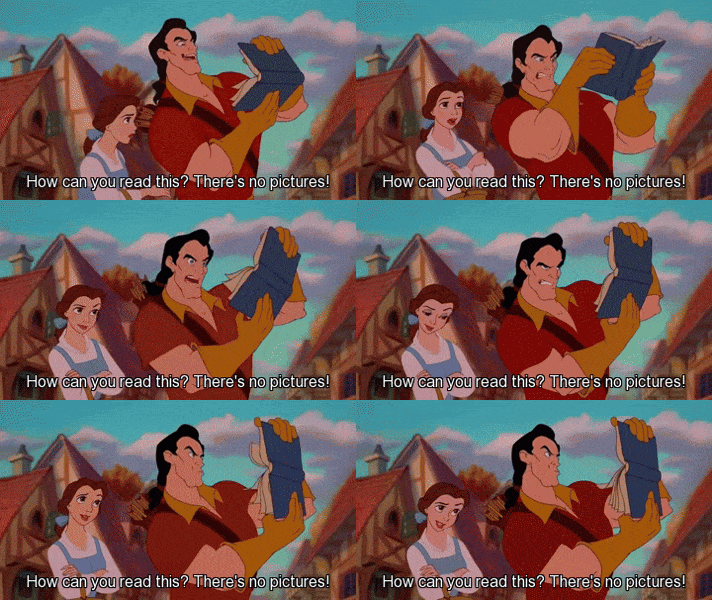 |
| me irl |
Now mind you, this isn’t to say
that fanciful turns of phrases and the admission/omission of certain
information in books due to narrative concerns are anywhere near the same thing
as depicting an entirely different outcome to World War II. Nor am I trying to
convey the message that works of capital-H History take anywhere close to as many
artistic liberties with the subject matter as do films, or that we should completely disregard scholarly works and fully switch to the visual image as a medium for
learning.
 |
| Actually on second thought... |
However, it’s my belief that the story of “The Man in the High Castle”
offers a few interesting lessons for its audience. The first is that the written
word is just as much a product of editing as are films, and that there can be
as many different depictions of the past as there are individual works. The
second and more important point, though, is that this discrepancy in what is
depicted isn’t something to be avoided but welcomed. By juxtaposing these different
interpretations, amateur enthusiasts and professionals alike are afforded
valuable insight into history and its formative process. Chances are you (hopefully)
won’t be hunted down by the secret police for your dutiful investigation into
the nature of truth and fact, but who knows? It might prove to be a worthwhile
use of your time.
[1] Rosenstone,
Robert A. History on Film/Film on History.
Harlow, England: Longman/Pearson, 2006. 2.
[2] Rosenstone.
History on Film. 127.
[3] Rosenstone.
History on Film. 134.
