Amy M. Tyson’s 2013 book, The Wages of History, is an in-depth
study of the professional reenactors employed by Fort Snelling, a historical
site in Minnesota. Her argument, eloquently
explained on page 23, is that “those who chose to invest themselves in the
worksite did so because they found it emotionally fulfilling to connect with
others through the medium of living history.”[1] To understand form and content at living
history museums, Tyson continues on the next page, “we need to understand the
larger contexts that shape the working lives of those delivering that content: public
history’s front line.” Her study,
however, is very limited in scope: she takes her findings mostly from Fort
Snelling, only occasionally discussing events and exhibits at such other living
history museums as Colonial Williamsburg.
I decided to take a look at the form and function of another group of
living history sites. For this blog
post, we’re going traveling.

In this class, we tend to focus
quite a bit on America. All of the books
we’ve read have been about American museums, or ways in which America chooses
to look at public history. Well, other
countries have museums too, and other countries do living history as well. Reenactments of the English Civil War take
place in Britain, as well as Roman Legions.

Napoleonic events draw great crowds in Europe, especially during the
bicentennial events of recent years.

Japan has very impressive samurai reenactments.
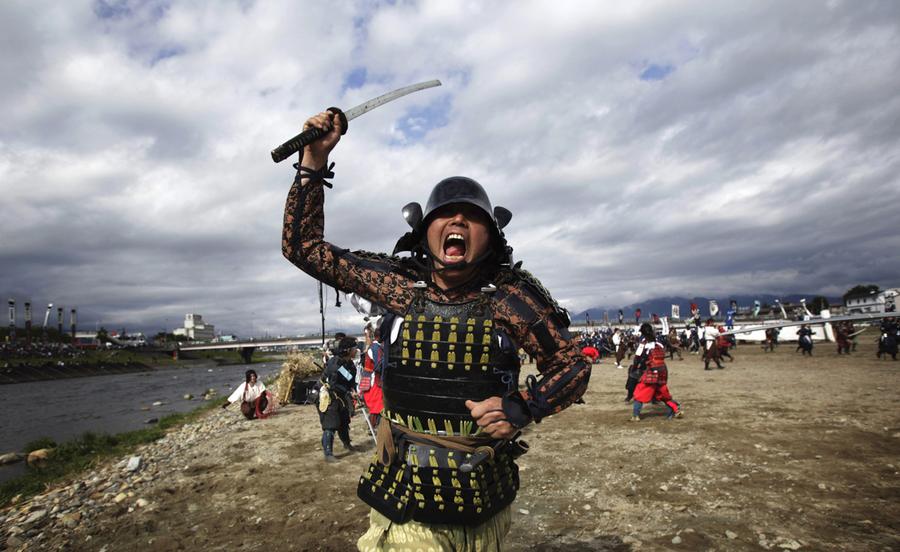
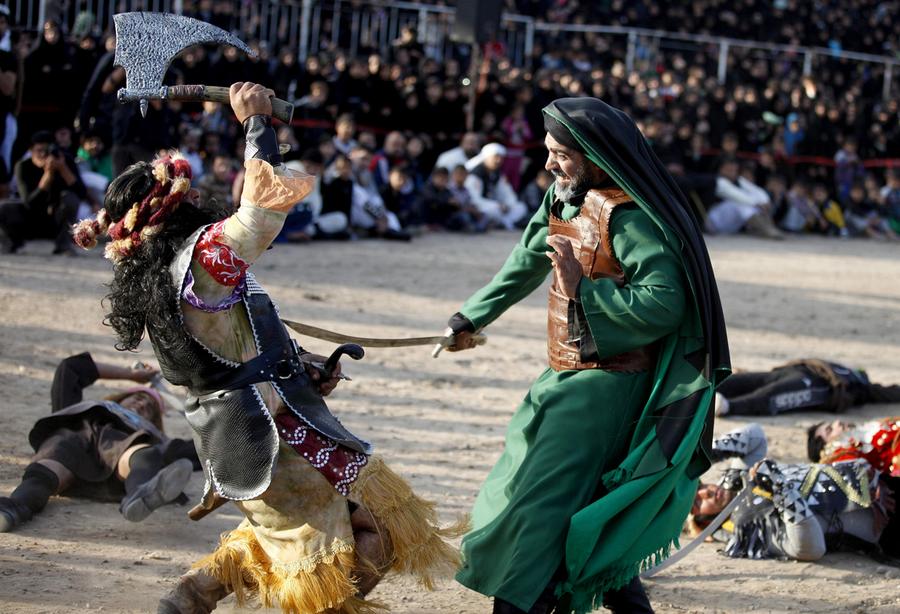
Shiite Islam has transformed reenactments in
Iraq into popular religious events, as has Catholicism in the Philippines.
But most of these events last a single day,
or in some cases, a weekend. However, things
are a little more extreme in China. If you want to see the battles of the
Chinese Civil War, you can go anytime: there’s a battle every day at 11AM, and
sometimes two battles on weekends. And
for a small extra fee, you can fight in them.
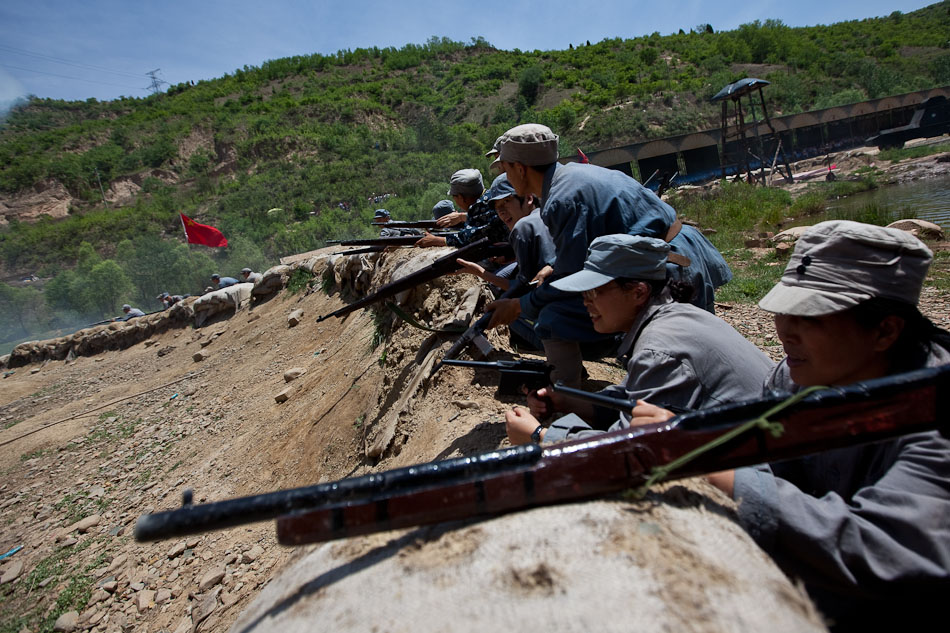
“Red Tourism,” or tourism based
around sites that have a significance relating to the history of the Chinese
Communist Party, is taking off in China.
Much of this tourism is to places in the city of Yan’an, in Shaanxi
Province, central China. Yan’an was an
endpoint on the Long March, and was seat of China’s communist government from
1937 until 1947. The city of Yan’an was
home to Mao Zedong during that decade, and many communist leaders spent time
living and training there. Yan’an was
captured in March of 1947 by Chiang Kai-Shek’s nationalist army, and it is this
battle that the Yan’an reenactment focuses on.

Three hundred and fifty paid actors
reenact the battle of Yan’an for one hour every day.[2] The battle features Nationalist KMT and
Communist soldiers as well as peasant villagers, and involves artillery, tanks,
and even a model airplane. The
performance costs 150 Yuan to watch, which equates to roughly 24 USD. Participating in the production costs the
interested visitor only an additional 50 Yuan (~8 USD).[3] After the battle, those who wish to may take
a photo in either communist or KMT uniforms, or even take a photo with an actor
portraying Chairman Mao himself. The
entire performance is filmed, and participants and spectators alike may
purchase a DVD copy after the battle.[4]

Yan’an has more to offer the Red
Tourist than just the battle. A visit to
Yan’an is incomplete without a tour through the Yangjialing Caves that Mao and
his followers lived in for a decade. The
three rooms of the cave are extremely neat and clean, with Mao’s bed made up
all nice and tidy. Those wishing to live
in closer communion to Mao may stay at the nearby Yangjialing Cave Hotel, built
into the side of a mountain in traditional Shaanxi style.[5] A nearby exhibit hall discusses Mao’s life
and policies, but only their positives: there is no mention of famines caused
by poorly thought out agricultural reform policies, the horrors of the Cultural
Revolution, or brutal political purges.[6] Other important Red Sites in and around Yan’an
include the Zaoyuan Site, caves home to the CCP Secretariat 1943-1947, and a
meeting hall for the Central Military Command.
Red-themed restaurants such as Red Classics cook up northeastern Chinese
food, served by waitresses in the dull blue cadre uniforms of the CCP.[7] A Long March-themed amusement park has even been
proposed to city, turning a traumatic event that killed thousands into a fun
day out for the family.[8]

2011 was a peak year for Red
Tourism because it was the 90th anniversary of the founding of the
Chinese Communist Party. In the year
2013, 786 million Chinese tourists visited over 100 Red Sites, spending a total
of 198.6 billion Yuan (23 million USD) on their travels.[9] An article by The Guardian reports that
Chinese sources claim 2,000 visitors to Yan’an’s Red Sites every day.[10]

Garish and kitschy though the Yan’an
sites may appear to be, many Chinese tourists approach them with a sort of
reverence. Many members of the Party
come on tours of Red Sites to reaffirm their allegiance to the Party, and to
try and understand the Party’s history. A visiting member of the Party explained
why Red Tourism was so popular to BBC reporter Michael Bristow: "We do
this to review history, strengthen our faith in the party, uphold its
traditions and improve our work.”[11] Ma Xiaoyu, a female teenage visitor to the Yan’an
sites, was quoted in The Guardian
saying that she came to Yan’an because modern Chinese “really wanted a look at
how Chairman Mao and those leaders lived in those times. They built up the new
China, so we need to remember them."[12]
She went on to say that visiting these sites and dressing in the dull blue
uniform of a cadre makes her feel patriotic.
Wu Kunliang, a middle aged engineer, came to Yan’an’s Red Sites with his
family. “Coming here helps one understand China’s red spirit,” he told Dexter
Roberts and Jasmine Zhao of Bloomberg.[13]

I find the thoughts of the
participants to be more interesting than those of the spectators. Interviewed by Time Out Shanghai, an actor who plays a Nationalist soldier
explains how he feels: “It’s hard work – we perform all the time, even in the
rain. There’s always a crowd here to watch.”[14] He makes 1,500 Yuan (~236 USD) per month, and
drives a motorcycle during the event. The
event has a very definite pro-communist (and anti-KMT) slant, so Time Out Shanghai asked about the ratio
of KMT to CCP soldiers. Surprisingly, recruitment
on the two sides is fairly even. “If you act with the Kuomintang, you get to
ride on motorbikes and things, but if you’re with the Communists there’s more
running involved.” Tang Qunshan, a
27-year-old visitor to Yan’an who also decided to join the Nationalists, told
Reuters that “by traveling to old revolutionary sites and taking part in
activities like these, I think we can experience the spirit of those old
revolutionaries."[15]

But why Red Tourism? Is it simply just a public trying to
understand its national history? Perhaps
there’s a darker political significance.
China’s communist government isn’t exactly known for presenting history
honestly. The government is in strict
control of all these sites, and it is the government that decides how to
portray this history. In Shanghai, a
sign at the site of the Party’s first congress sums up the message of the Red
Sites: "The founding of the Communist Party of China is the inevitable
outcome of the development of China's modern history.”[16]
There is no alternative view of history here.
The Communist Party was always destined to win.

So, it’s easy to list the
disadvantages of government control of public history, but are there any
advantages? How involved in history
presentation (and living history in particular) should the government be?

In The Wages of History, Amy Tyson describes the difficulties that
American living history sites had in dealing with traumatic events from the
past, such as slavery and relations with indigenous peoples. It appears that China has fewer issues with
the “cleaning up” of horrific battles and divisive social conflict, especially
with the plans to build a Long March-themed amusement park. Does America have any analogues to Red
Tourism, such as Revolutionary or Civil War history sites? How do these sites compare to China’s Red
Sites in terms of propaganda, messages, and presentations of history?

The Yan'an Battle can be seen in disappointingly low resolution here (no English)
A video of a similar show in Shaanxi can be seen here (with English!)

Me in real life.
[1]
Amy M. Tyson, The Wages of History:
Emotional Labor on Public History’s Front Lines, (Amherst and Boston:
University of Massachusetts Press, 2013), 23
[2]
Dexter Roberts and Jasmine Zhao, “In China, Red Tourism Stages a Comeback,” Bloomberg Business, July 10, 2014,
accessed October 30, 2015, http://www.bloomberg.com/bw/articles/2014-07-10/chinas-patriotic-red-tourism-makes-a-comeback
[3]Jake
Newby, “Tour the ‘Cradle of Revolution’ in Yanan,” Time Out Shanghai, October 17, 2013, accessed October 30, 2015, http://www.timeoutshanghai.com/features/Travel-Travel_around_China/14831/Tour-the-cradle-of-the-revolution-in-Yanan.html
[4]
Kirk A. Denton, “Yan’an as a Site of Memory in Socialist and Post-socialist
China.” In Marc Matten, ed., Places of Memory in China: History,
Politics, Identity, (Leiden: Brill, 2011), 271
[5]
Newby, “Tour the ‘Cradle of Revolution’ in Yanan.”
[6]
Edward Wong, “Revolution isn’t a Party, but it Draws Tourists,” The New York Times, December 30, 2010,
accessed October 30, 2015, http://www.nytimes.com/2010/12/31/world/asia/31china.html?_r=0
[7]
Maxim Duncan, “China’s ‘Red Tourism’ puts the Party back into Communism,” Reuters, June 30, 2011, accessed October
30, 2015, http://www.reuters.com/article/2011/06/30/us-china-party-tourism-idUSTRE75T19J20110630
[8]
Denton, “Yan’an as a Site of Memory,” 273.
[9]
Roberts and Zhao, “In China, Red Tourism Stages a Comeback”
[10]
Tania Branigan, “Communist Heritage is Good Business as China Prepares for 60th
Anniversary,” The Guardian, September
27, 2009, accessed October 30, 2015, http://www.theguardian.com/world/2009/sep/27/china-60-anniversary-communism
[11]
Michael Bristow, “China’s Communist Party: ‘Red Tourism’ in Yan’an,” BBC News, June 30, 2011, accessed
October 30, 2015, http://www.bbc.com/news/world-asia-pacific-13973159
[12]
Branigan, “Communist Heritage is Good Business.”
[13]
Roberts and Zhao, “In China, Red Tourism Stages a Comeback.”
[14]
Newby, “Tour the ‘Cradle of Revolution’ in Yanan.”
[15]
Duncan, “China’s ‘Red Tourism’ puts the Party back into Communism.”
[16]
Bristow, “China’s Communist Party: ‘Red Tourism’ in Yan’an.”

While completing the reading for this week I constantly reflected back at our time at Old Fort Niagara, I really had not thought too much about other countries having their own take on 'living' history. With China being a Communist country I wonder exactly what kind of impact this would have on people working at the sites. Also I would guess that there would be some sort of bias involved in how they expect information to be presented. With that being said, it also makes me wonder what biases are presented in our variations of living history.
ReplyDeleteDavid raises interesting questions about how public history functions in other countries that I think can be more broadly to all of the issues we have covered in this course. For instance, how would the survey results from The Presence of the Past differ if those questions were posed to citizens of France, Australia, Burma, or Tanzania? Is our consumption of history distinctly American, or do commonalities exist regardless of culture or national identity? Moreover, does public history even serve the same purpose in other countries? If a student in this class has aspirations of pursuing a career in public history outside of the United States, how might this affect his or her work?
ReplyDeleteOn the subject of these sort of living history sites dealing with traumatic events, it brings to mind less the battles and more the surrounding issues. For example, the one about slavery that makes every visit to some sites incredibly awkward. And that’s actually something that I consider a plus for any site that has it, because those should be moments of incredible awkwardness. I remember reading an article about what I believe was Williamsburg where they talked about how awkward the slavery thing was, and it was never more awkward than when you had to explain it to children who then asked how much it would take to buy the employee (thankfully they seemed to be asking to see how much it would take to set them free). As much as these sites are fun to watch and take part in, riding down Nationalists on motorcycles and doing faux bayonet charges, it’s good that more places don’t take China’s approach of cleaning things up.
ReplyDeleteI enjoyed the post, Dave. It was a little jarring to see so many pictures, but I understand the inclusion of so many, to emphasize the various attractions and their relationship to the Communist government and its history. The selection of this particular site and sampling of tourism does raise some interesting questions indeed. While I have briefly thought of history tourism in other countries, public history never rightfully came to mind, and this selection raises the very fine line of how to present public history. Is this Red Tourism a mere positive reflection of the Party only, is it propaganda, or both? While I personally don't support China's reasoning behind the tourism, it would seem that active participation on behalf of the visitors is a great example to mimic, to get visitors to truly immerse themselves in the history. To some degree, Fort Niagara as an example, does follow suit. Although, can reenactments truly be considered the same thing? Several events are held throughout the year where reenactors and visitors can participate, but rarely do the two roles intersect. Would public history sites be better or worse for such policies? Regardless, I'd be very interested to see Tyson's kind of observation and analysis applied to other sites in the US.
ReplyDeleteGreat post. I can't help but relate the phenomenon of Chinese re-enactment to that of our (American) own. Although popular re-enactment events such as the Battle of Gettysburg and D-Day aren't explicitly funded by the state (besides maybe a federal or state grant/charitable contribution), American and Chinese citizens seem to get a lot of the same things out of active participation. Dressing up and singing Mao's praise may seem rather cultish to the West, but are sentiments such as an affirmation of national identity, a desire to connect with the past, and an interest in how historical figures lived really so foreign to us? Something tells me not so much.
ReplyDeleteLoved this! I'm so glad that you found a way to connect this reading to something non-Western to expand the horizons of our studies! Your discussion of "Red Tourism" is very interesting and it seems as though the Chinese view this tourist site as a sort of pilgrimage. This reminds me of our reading of Tourists of History in which people would take trips to places like New York City or Oklahoma City to pay tribute to those tragic sites, almost like a duty to their country. As for your discussion of the government's role in depicting public history I thoroughly appreciate you posing advantages of it. Maintaining a national identity is something that many countries struggle with, and the government having a hand in how their narrative is portrayed would help to emphasize a collective history and an united country as a result.
ReplyDeleteGreat post!! It was very interesting to read. I would like to focus on the term Tyson uses, public history proletariat, since I found it to be an interesting idea. In another class this week we were discussing the purpose of museums, whether they are strictly educational in the sense that facts are thrown at the visitor, or if there is a customer service or hospitality sense to museums as well. I really like how Tyson combined these two viewpoints with the idea of a public history proletariat. I also thought back to our visit to Fort Niagara and feel as though Toby did an excellent job in this regard. He demonstrated how he actively engages school children while teaching them as well. I really enjoyed reading this book.
ReplyDeleteGreat post Dave. It is an interesting comparison point, and once you strip away the communist veneer, it's almost identical to the reenactments we have here in the States. Like Joe said, national identity, connecting to the past, interest in the lives of historical figures, and i'm going to add celebration of national victories, it's really not all that different. As for the history/propaganda debate, history, unfortunately, is always at the mercy of whomever is telling the story. For a highly nationalistic state like China, some embellishment certainly isn't out of the question.
ReplyDeleteOutstanding post Dave!! I enjoyed the direction you went with the post, and going non-american, as it was great to see the traditions and customs from other nations. From all the books about museums we have read this semester, it seemed as if there was a little of each in this post which was enjoyable.
ReplyDeleteAn old friend from high school used to work at Fort Niagara as a reenactor during the summer. I remember stories he told on how he felt he was apart of history, and that he was doing his duty to remember local and national history. This proves that Tysons quote that you used Dave is in fact true. Lastly, it seems if the United States needs to step up their historical reenactment game, as China does an tremendous job engaging their citizens into "Red Tourism," and their history.
Good post David. As my old history teacher used to say, "Ain't no party like the Communist Party."
ReplyDeleteIt is always interesting to see how other cultures interpret and live their history. I remember seeing the humongous re-enactment of some of the Napoleonic War's biggest battles, including Austerlitz and Waterloo on the internet, which were on a scale similar to the largest Civil War ones.
The Chinese example is especially interesting considering it is so closely tied with the state and its survival, and seems to serve an important propaganda purpose. While that's not to say that American sites are not propagandist, but the survival of the United States is not dependent on loyalty or memory of the Founder Fathers and our history like theirs seems to be.
I loved the post and I like the fact that the it focuses on living history taking place out of the United States. The first video clip shows tourists enthusiastically participating in the reenactment, which is a good way to get the community interested in their own history. this is something that China has in common with the US. Our time at Fort Niagara is an example of this too. I enjoyed briefly being a part of the King's Army and learning some of the ways soldiers experienced life.
ReplyDeleteThis goes to show that living history is not just an American thing, but that is can be experienced world wide.
Thanks for showing how relevant living history is outside of the US and the West in general. A comparison of how living history is disseminated throughout the world is needed. I noticed that the focus of Chinese living history is military based, which is very similar to most of the living history sites in the US. Why is war based living history so popular I wonder. I know there are other sites in the US that focus on other aspects of history such as Colonial Williamsburg, but I know there is a emphasis on war/independence even there. The popularity of past wars is evident in popular culture so I am guessing this is the draw to sites like Fort Snelling, but I dont sense there are many other living history sites out there. Perhaps I am just not looking hard enough. Finally, how we expierence living history as spectators is a good point that can be explored further. I also love the Magic School Bus reference!
ReplyDelete